Showing posts with label Food. Show all posts

Feb 1, 2012

Rediscover the Profound Food Culture : Akita’s High Quality Fish to Complement the Great Sake Choices!

Kyukamura’s annual dinner event of Akita’s local sake and food has been taken place in January and February. January event is just ended last weekend. These beautiful and delicious dishes were specially designed to complement the rice wines presented at this event.


The meal started with a glass of your choice of Daiginjo shu, each crafted by two brewers, Hideyoshi’s Suzuki Shuzo and Ranman’s Akita Meijou.

Fukuochoko cup with a special design
of Tatsuko and her dragon
After toasting, a number of small dishes are delivered to our table in a traditional Kaisaki manner – starting from appetizers, sashimi, soup, steamed, fried, roasted, marinated, rice dish, palette freshener, and end with a desert – which makes it in total of 11 times.

The food is themed in fish caught off the coast of Akita during the kan (coldest) season. The dinner included ingredients of 7 different seafood: codfish, bonito, anglerfish, yellowtail, crab, red trout, and salmon.

It is nearly impossible to show you every detail in here; we also want to keep it secret for the February event, so here we give you just a few glimpses of the unique dishes:

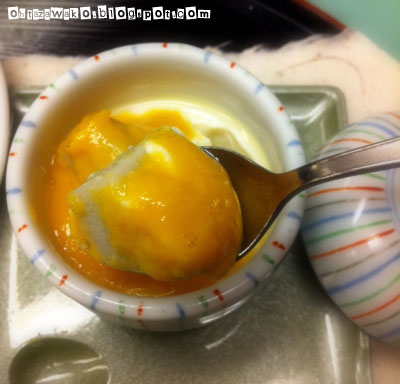

One of the first 3 appetisers:
Yosedofu Shuto-ankake
The appetizer plate featured 3 different dishes. Yosedofu Shuto-Ankake (picture right) was silky and flavorful tofu hiding a few chunks of yams covered with flavorful Shutou sauce made with bonito’s stomach. Another dish was a small cake of anglerfish with some miso.

At the height of season, codfish was served as sashimi: the meat seasoned with Konbu seaweed and roe seasoned with citron. It was presented in Akita’s famous Kamakura. 

An absolutely mind-blowing dish was Soy Milk Shabushabu of Yellowtail and Vegetables. A hint of Sakekasu (sake lees) was added to give the soy milk a wonderful flavor. Parboiling the fish and veggies made the broth so tasty that we just couldn’t stop!


Yellowtail was served again later as cooked and in accompaniment with radish, creamy sauce, and some red trout roes. Codfish also returned to the table – now steamed with Japanese turnip. This dish was served on the turn of “Shiizakana,” literally means “forcing you to make you drink more.”

In another dish, salmon meat and roe as served in Ochazuke style (with rice and tea).

A scoop of dried persimmon and Tofu with a goji berry was refreshing! And so as the 11th dish, sakekasu mousse with mint jelly and strawberries.

The meal could not be more satisfying! Every single dish perfectly matched with the characteristic flavor of Akita’s sake – it did not only compliment the subtle but rich flavor of sake but also left us a strong impression of how beautiful and profound Akita’s food culture is.

The February event will feature different dishes as it reflects the most delicious ingredients of the season. For more information, please inquire Kyukamura Nyuto Onsenkyo.

Nov 25, 2011

Persimmon-Pickled Radish For Your Next Addiction!

Persimmon is a common fruit in Japan. The Japanese kaki is yellow and orange. The taste is very sweet (high in glucose), and the crisp pulp turns juicy and jelly-like as it gets matures.


The Common "Fuyu" Type


How is “Kaki” Enjoyed?

The young fruit has a high tannin content, which makes it quite bitter and astringent to the taste. Usually, a special type of shochu alcohol is used to remove the uncomfortable taste. Or, the immature fruit is peeled and hung with strings (often seen under the edge of roofs) until it is dry and enjoyable. “Hoshigaki” (dried persimmon) are popular accompaniment for teas as snacks.

Dried Persimmons in May at Komagatake Onsen Restaurant


“Radish” is Unnecessary to Mention, When it Comes to Pickling.

Besides eaten raw or dried, the fruit is also used as pickling agent to make Kakizuke, which literally means “Persimmon-Pickled.”

Smoking Radish


Just like “Iburigakko,” another type of radish that is smoked and pickled, the names imply only how it is pickled but not what is pickled. In other words, they omit “radish” as unnecessary to mention, because it is assumed you know that is a radish already.


What’s more interesting, Akita is the 2nd largest consumer of radish of Japan! The average consumption per person is almost 20kg / 44lbs, almost 1,5 times as much as the average Japanese person, according to the 2010 consensus by Ministry of Internal Affairs and Communications.


This explains how much Akita people are obsessed with various techniques of pickling radishes using different methods – smoked, with glory vines, grapes – and of course, with persimmons!


Persimmon-Pickled: Sweet, Sour, And Crispy Radish To Get Addicted!

To make Kakizuke, "Persimmon-Pickled Radishes", all you need is fresh radishes, young (astringent) persimmons, and salt. You need only these 3 ingredients to get this simple and natural flavor. Then the radishes are preserved over 20 -30 days, with a heavy rock or weight on top of it, until it turn out sweet and aromatic.


Persimmon Tree at the Matsumoto Residence

Persimmons are broken into pieces.

Salt and the ground persimmon are poured on top of the washed whole radishes.
 
The radishes are layered in a bucket.


 Kakizuke, ready to be served.

The fruity sweetness of persimmon and sourness of radish come in perfect balance! The crisp texture is also another reason why you would get addicted to it. Before you know it, you will be eating lots of radishes and clearly understand why Akita people consume so many radishes in a year!

You can find it at local grocery stores or served as a side dish at restaurants and hotels. Enjoy!


Nov 24, 2011

Not Another Natto Hand Roll - Famima Introduces A Unique Kind Designed by Ms. Yamate of Kashintei Shirahama!

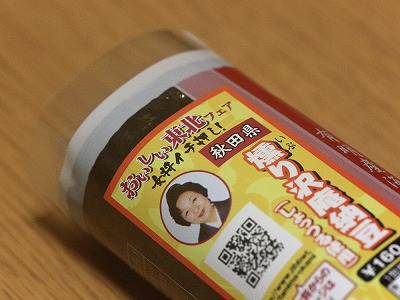
The Japanese convenience store, Family Mart, has introduced a product designed by the manager of an exquisite hotel at Lake Tazawa, Kashintei Shirahama (花心亭しらはま).

"Temakizushi Iburitakuan Natto"
手巻寿司 燻り沢庵納豆 (しょっつるし使用)
Mr. Yamate has designed this hand roll with characteristic ingredients from Akita Prefecture. This is not a typical Nattomaki you could find – this hand roll features not only the natto, fermented soybeans, but also contains finely-chopped iburigakko, smoked pickled radish, and seasoned with aromatic shottsuru, the original fish sauce made with hatahata fish – both are popular specialties from Akita Prefecture.

Mr. Yamate is known for her classic style and her talent as an Okami who manages  the popular hotel. She has previously produed some unique product such as this beautiful o-manju cake.

Not a typical Nattomaki you can find!

With the subtle saltiness by the fish sauce, the hand roll can be enjoyed either alone or with a hint of some soy sauce. The hand roll is only 160 Yen each.

This is a commercial campaign by Family Mart to promote the delicious foods from Tohoku region that are recommended by famous Okami (lady masters) representing each prefecture. The campaign started on November 15 and will continue until December 12.

Aug 11, 2011

Green Tourism Monitor Tours in Semboku City (Experiences at Jinkichi in Tazawako)

The Semboku City's Green Tourism Monitor Tour has just started in July. The second group enjoyed several outdoor activities and stayed at a Noka-Minshuku (農家民宿), a farmer's inn, in Tazawako Area.


Mrs. Taguchi of Jinkichi and the monitor tour participants.

On Day 1, the participants experienced canoeing at Lake Tazawa, radish harvesting, pizza-baking in stone bake oven, and BBQ. On Day 2, they learned to make Keiran(鶏卵), traditional rice cakes on bamboo leafs. They later harvested Moroheiya (Molokhiya) in the greenhouse before calling it a day.

An important task required to the participants was to posts updates on twitter and share it with hashtag #semboku_gt . The participants shared lots of excitements and useful information on what you could do in Tazawako Area.


Staying at Jinkichi, a Farmer's Inn at Lake Tazawa:

Jinkichi (甚吉)is a farmer’s inn with a great agricultural foundation. The family cultivate various types of vegetables and sell them in and out of Semboku City. It is a family-owned inn, which has been hosting students and tourists for many years. Mrs. Taguchi is designated as a Female Agriculture Specialist by Akita government, and her husband, Mr. Taguchi is a schoolmaster of local Ski School. They both are very hospitable and make sure that you feel at home -- That is why the guests call them as "Okasan" (mom) and "Otosan" (dad).


Learning to Make Traditional Sweets and Harvesting Molokhiya:

On Day 2, the main activity was to make Keiran, a traditional steamed rice cake in Tazawako region. Keiran (鶏卵) is made during the hina-matsuri, the doll festival, from late February to early March. Mrs. Taguchi has prepared the white dough and colored dough.


White dough (rice flour, wheat flour) and Colorful doughs (food colorings, sesame paste)

First, Mrs. Taguchi explained the procedure and ingredients. She showed an example step-by-step: measure the white dough 50mg, and wrap 30mg anko bean paste inside; make a smooth ball; create your own using the colored dough.


@akitagt Jul 31, 9:57am
“Okasan”shows us how to make Keiran, Sweets from Tazawako. We girls get more excited! Marveled at how skillfully she makes it! #semboku_gt http://twitpic.com/5yis0c

お母さんがお手本を見せてくれながら、田沢湖のお菓子「鶏卵」作りが始まりました。女子のテンション上がります。それにしてもお見事な出来栄え

Measure, roll, and decorate to make their own Keiran.

After steamed for 14 minutes, they were immediately cooled in running water and placed on top of prepared bamboo leaves. The group created many character shapes as well as more traditional shapes like peaches, flowers, rabbits, etc.


Traditional Shapes


@VIOLETTA_116 Jul 31, 12:01pm
#senboku_gt We are trying to make some Keiran! The delicate work make us speechless! LOL http://t.co/XCZo5PL 
郷土菓子・けいらん作りに挑戦しました!細かい作業にみんな無言! (笑)

Later, the group was taken to the back of the house, where they experienced harvesting Moroheiya in a greenhouse.


Amazing view!

Mrs. Taguchi tells stories about agricultural life. Very interesting!


@semboku_gt Jul 31, 4:19pm

@semboku_gt: We were amazed at how versatile and flexible Jinkichi-san is!  RT@akitagt: We are sure that we could all meet again. That is why I was able to say “see you” to Okasan. We enjoyed the monitor tour in Tazawako. Thank you.
今回の甚吉さん http://j.mp/oz0DAA 農家ならではの多彩な応用力、感服しました RT @akitagt またこのメンバーで会える気がするから、民宿のお母さんにも笑顔で「またね」ができました。田沢湖で過ごしたモニターツアー楽しかった #semboku_gt

@yachu5088 Jul 31, 8:41pm

I’ve noticed that many farmers who bend the bodies in U-shape in the field are mostly elderly people. It takes so much work to harvest one vegetable. In a few minutes, we felt so exhausted. It must be a normal work for those farmers. It is admirable!
休みの日、腰をUの字に曲げて畑仕事をしている方達は高齢者の方が多いなーと感じてました。野菜一つ育てるのも収穫するのも大変な労力。たった数分収穫しただけであの疲労感。農家さんは当たり前なんだろうけど、頭があがりません。 #semboku_gt


The Semboku City Green Tourism Monitor Tour still continues until December. The tour dates are announced about a month in advance. It is easy to sign up and worthwhile for all of the people who love a simple, rural lifestyle of Japan.

May 19, 2011

Make A Pizza in a Stone Oven at Tazawako Campground!

Besides managing a campsite at Lake Tazawa and rents you camping equipments, Tazawako Campground  (田沢湖キャンプ場)offers you a variety of outdoor activities both in the surrounding nature – in Lake Tazawa and nearby rivers and mountains – and at the campground!

The Outdoor Sports Tours extends to the surrounding area and varies as in trekking, canoeing, kayaking, etc. Most recently, they introduced the Outrigger Canoeing Tour, which is designed for the beginners of river sports!

On-site Activities include some fun cooking experiences, like Stone Oven Pizza Activity!


Ishigama (Stone Oven) Thomas!


(Photos/ Tazawako Campground)


Stone Oven Pizza Activity

Date:
Monthly Announced

Time:
10:00 – 16:00 (At Every Hour / 7 Times)

Fee:
1,500 Yen (One 25cm Pizza)


This Month:
May 28th and 29th

Topping of the Month:
Choose from
Spring Sansai (“Mountain Vegetables”) like Butternut Sprouts
or MIX Pizza (with some various ingredients)

This is apopular activity that welcomes both overnight campers and day-trippers. The staffs will assist you to make your own pizza in the handmade stone oven and enjoy the fun time with your family and friends!


In winter, Tazawako Campground closes its campsite; however, they relocate a Tipi to Tazawako Kogen Area and inside offer you a Baumkuchen (a layered cake) Making Activity !


(Here is some more photos of Baumkuchen Making in winter.)
 

May 17, 2011

Soba Goro's Hot Zaru-Soba with Seasonal Tempura!

Soba Goro at Tazawako Ichi in front of JR Tazawako Station is a popular restaurant where you can enjoy a high quality buckwheat noodles!

Soba Goro serve both hot and cold noodles with various types of toppings. If you are wondering what you could try to have a seasonal flavors, try a plate with some tempura! Like this one:


On-Ten-Zaru-Soba (温天ざるそば)


Buckwheat noodle (soba) with hot dipping sauce are served with tempuras of seasonal ingredients. The selection of Tempura varieds depending on the season. On this day in late April, they served shiitake mushroom, shrimp, hirokko (wild onion), and kogomi (fern).

The flavorful buckwheat noodles, crispy tempura, and the sauce match so perfectly! We loved it :) The items on the menu are available while the supply lasts. We recommend you to drop by early! ENJOY!

Apr 19, 2011

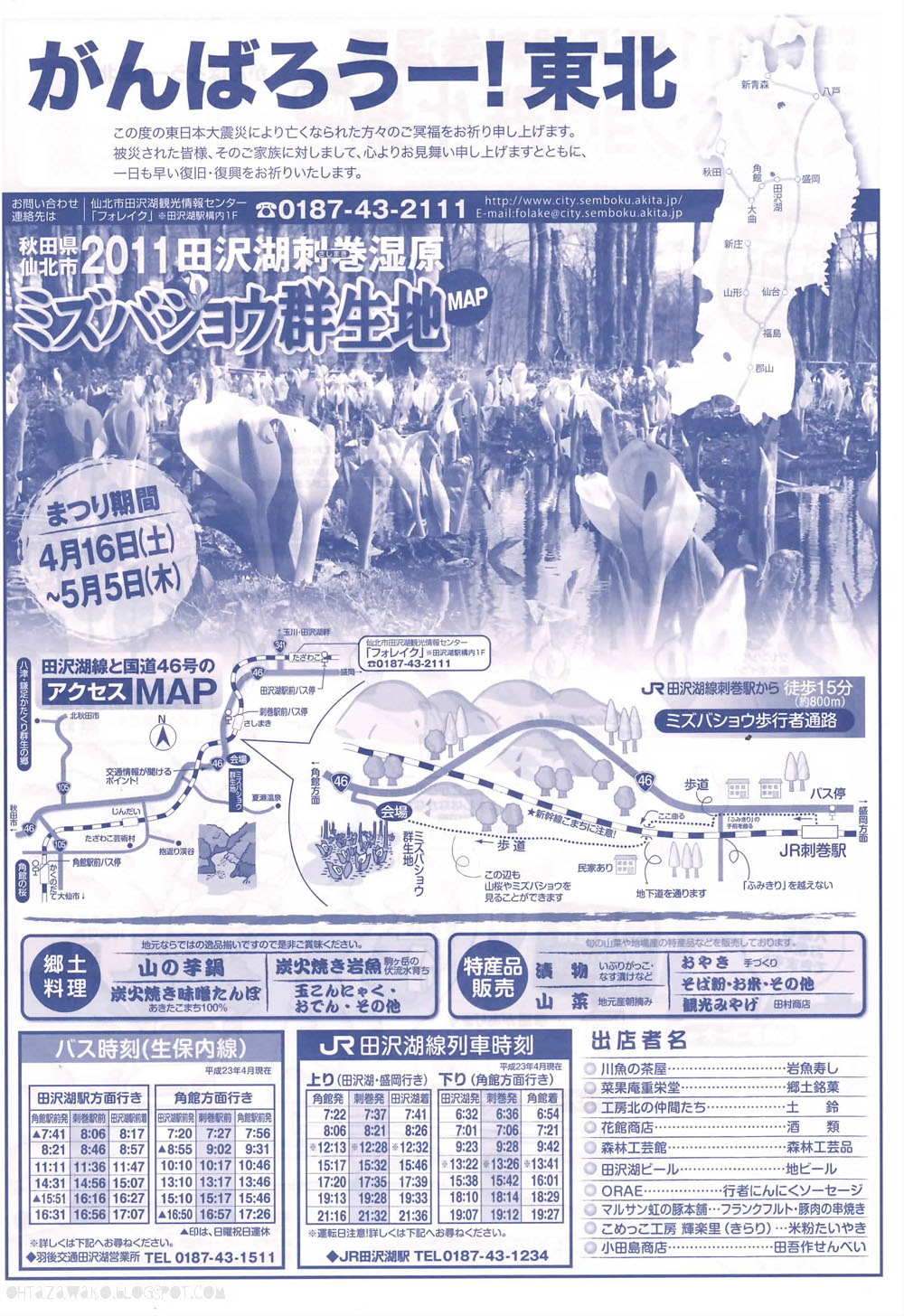
Sashimaki Mizubasho 2011 (Access/ Food / Souvenirs)

has started on April 16th and continues till May 5th.


Access:

DRIVE – Route 46 in between Tazawako and Kakunodate Station. If you are driving eastbound from Kakunodate Area, the colony will be found on your right hand side before JR Sashimaki Station. Parking capacity is 70 cars and free of charge.

WALK -- 15 minutes walk from the nearby JR Sashimaki Station. When you exit the station, make an immediate left. Just follow the event signs and continue walking on the paved way. You may find some wild cherry blossoms and Mizubasho flowers as well, but  you are not there yet; continue until you get to the event site.

BUS – The bus lines connect JR Stations (Tazawako, Sashimaki, and Kakunodate). See the time-table below (left corner) on the flyer.

JR TRAINS – Take a local train on JR Tazawako Line; Shinkansen Express do not make a stop at Sashimaki Station. See the time-table below.


Local Food / Souvenirs:

Traditional Cuisine – Yama-no-imo Nabe (Hot Pot with balls of grated yam), Miso-Tanpo, Iwana (Japanese Char), Tama-Konnyaku, Oden, etc.

Other Local Specialties – Pickled Vegetables (Iburi-gakko, Eggplants, etc), Fresh Sansai (Wild Delicacies), Home-baked Oyaki (rice cake), Buckwheat Flour, Rice, Snacks, and Sweets, etc.

Other Souvenirs-- Iwana-sushi (Pressed Sushi with Japanese Char), Dorei (Pained Clay Bells), Liquors, Woodcrafts Goods, Tazawako Beer (Bottled Craft Beer), ORAE's Sausage with Alpine Leek, Nijinobuta Sausages and Pork on skewers, Rice-flour Taiyaki (fish-shaped pancake with sweet bean paste inside),Tagosaku Senbei, etc.


(Clockwise) Oyaki, ORAE's Sausages, Snacks,Yama-no-imo Nabe, Rice-flour Taiyaki,
Tazawako Beer (Sakura-kobo Beer), Miso-Tanpo, Woodcrafts, Dorei (Clay Bells).


Mar 9, 2011

O-manju from Mizusawa Onsen and Kashintei Shirahama

On your travel in Japan, you would probably notice: no matter where you go you will find boxes of sweets for souvenirs. Perhaps the most common kind is o-manju (お饅頭), which is a small steamed cake containing paste of sweet beans ("anko")

Also, in Tazawako, there are many different types of o-manju boxes available for your souvenir. You can find them at souvenir shops like Tazawako-ichi, Tazawako Kyoei Paresu, Tazawako Rest House, etc. And you can find specially designed ones at hotels, too.

Mizusawa Onsen's O-manju, the white anko (bean paste) is good!

Rotenburo Mizusawa Onsen gives away the special o-manju only four times a year. During the Tazawako Snow Festival at Tazawako Ski Area (only a few minutes away), the popular hot spring facility welcomed guests with a free o-manju! Theirs are bigger than the average size and specially made by a local pastry shop, Masaki Kashiya (near JR Tazawako Station).

Kashin-tei Shirahama (花心亭しらはま) is one of the most exquisite hotels on Lake Tazawa. While they accommodate more than 80 guests in their 5-story building, they give you the most personalized care and relaxing moment with the most beautiful view of Lake Tazawa.

The o-kami-san (lady manager) of Shirahama, Ms. Yuko Yamate, is a very nice lady and has a sophisticated sense of hospitality. Even this tiny o-manju designed by her can tell you so much about it: white and delicate sponge containing kabocha (Japanese pumpkin) paste with the salty dry sakura (cherry blossom) on the top! It’s delicious and goes perfectly good with your green tea!

Kashintei-Shirahama's O-manju

Dec 13, 2010

Honey Cream Puff at Bee Skep (and how to Impress your friends)

Bee Skep Yama-no-Hachimitsuya (山のはちみつ屋) is a honey specialized shop located 3 minutes away from Shirahama area. It has been known for its variety of honey-themed products and the pastry shop.

Many of their in-store products are on sale on their website. However, there are a few things that they have it available ONLY AT THE STORE!

Bee Skep’s honey Cream Puff is perhaps their signature sweets. It is only 175 yen and look at this volume! Inside it is filled with rich honey-sweetened cream that is surely satisfying.


Available only at the store!

By the way, Japanese people typically call such dish “shoo-cree-mu”!

Yes, just like “shoe cream”. Haha!

But of course, it doesn’t come from the same word. It is a Japanese lexicon of foreign words that derives from “chou” (French) and “cream” (English). Just a trivial fact that you could impress your friends with when visiting the store ;)

Don't forget about a cup of coffee. It is only 100 yen and refillable! --Fresh coffee, tea, and green tea latte is ready right in a minute.

Another impressing trick? --Print out a page from here and fill it out. You will have a free cup of hot honey lemonade! (FREE COUPON is valid till Dec 30, 2010.)

Yum yum....

Oct 1, 2010

Harvest Festival 2010 at Arupa

Arupa Komakusa (アルパこまくさ), an onsen facility that is perefect for Komagatake hikers on a day-trip. The facility features a rotenburo (露天風呂), an outdoor bath with a beautiful view of Lake Tazawa. A restaurant has a great selection of rice and noodle combinations including local specialties like Inaniwa Udon(稲庭うどん), Tazawako B-men (田沢湖B麺), and Menkoi-Komachi (麺恋こまち).

Arupa Komakusa's HARVEST FESTIVAL
 Oct. 16- 17th, 2010.


Akita's fresh harvests will be available!
Wild mushrooms from Tazawako Area
Raw honey from Kakunodate Area
Saimyoji-guri Chestnut from Nishiki Area
Various fruits of Akita Prefecture

Also Available:
  Hiking and backpacking gears, equippments, and clothing! 
At an information tent by ICI Ishii Sports Inc.

Sep 30, 2010

A Quick Bite: Crispy Noodles To-Go

Menkoi-Komachi (麺恋こまち)is another rice product from Semboku City!

Menkoi-Komachi (麺恋こまち)

 
Semboku City community is making a great effort to invent new rice dishes such as Jindai Curry (あいがけ神代カレー) and Tazawako B-men (田沢湖B麺)! Here is another one!

Stir-fried veggies and meat in thick ankake sauce is served over deep-fried thin rice vermicelli! It is sold in a to-go package— the crispy noodles and saucy veggies are individually wrapped. Available as both to-go and here order.

Pour the "an" over the crispy noodle!

Ingredients:
komatsuna (Japanese turnip), eringi (Japanese Oyster Mushroom), 
carrot, ginger, dried shrimp, and chicken.
Garnished with a slice of lemon.

Having been introduced by the City earlier this year, Menkoi-Komachi has been popular for its catchy naming and the price—only 250 yen ! Menkoi means "adorable" in Akita dialect, written with double meanings of noodles (麺)and love (恋). The name, along with the calligraphy on the package, was created by the students of Kakundoate Minami High School. The recipe was developed by local chef.

Menkoi-Komachi (麺恋こまち)can be purchased at:
Tazawako Ichi  (田沢湖市)
Tazawako Heart Herb (田沢湖ハートハーブ)
Arupa Komakusa (アルパこまくさ)
Murakko Bussankan (むらっこ物産館)
Kayokan (花葉館)

Sep 13, 2010

What is Jindai Curry?

Jindai Area is known as the producers of Japan’s #1 quality rice. Needless to say, the rice consumption is the most important in promoting the economy in the region. That is what the Jindai Curry is all about.


Now, Curry and rice is a signature home-style cooking in Japan. Japanese curry might not like you would expect from Indian curry. It is mainly made of curry powder, flour, and oil for the roux and served with various kinds of vegetables and meat. Some might say it is not as spicy as the Indian, but flavorful as much that it boosts your appetite to eat more rice. Rice and Curry are married and unseperatable forever.

Japanese curry was introduced by the British and Indians in the Meiji era (1869-1913). It was not until the Showa 30s (1950s) that curry became a common dish in the rural region. In Jindai Area, home-made solid roux of curry powder and flour fried in a pan was rather common. Vegetables, fish sausages, and canned whale or mackerel were the main ingredients to be stewed with the roux and seasoned with soy sauce.

Today the modern style curry has more intricate mixture of spices. Back in the 1950s, the lighter Jindai curry was more suitable for children and quite popular at home. As the solid curry roux was available at local grocery stores in the 1960s, the cooking methods became less common but still remains in a few homes as a Granma’s style!

Jindai Curry combines both the same ol’ Granma’s Style and today’s modern restaurant style. It is served side by side with a bowl of white Jindai Rice (神代米)a half-boiled onsen egg, and slices of iburi-gakko, another Akita's specialty, smoked-and-picked radish.

Jul 15, 2010

All-You-Can-Eat and Onsen in Nyuto

Finding the right kind of meal could be difficult in Japan, especially when you have a special preference for philosophical or religious reasons. Or, maybe you find the Japanese portion too light or small for you.

Kyukamura Nyuto Onsen-kyo solves everything, offering a buffet with various items for all-you-can-eat!


What makes Kyukamura buffet so special is that they offer items in various cooking styles --from regional cuisine to typical Japanese and western style-- while using locally-grown, freshest ingredients!


Kyukamura offers special deals for an overnight accomodation, starting from 10,700 yen, including two meals both at the buffet. They also offer a special deal for day-trippers: an all-you-can-eat dinner with a dip in Onsen for only 2,000yen.  

Considering the bathing for day-trippers ("higaeri nyuyoku") is 500 yen and until 5p.m., a buffet and onsen for this price is very reasonable! If you are interested, please let the hotel know before you arrive. The buffet is available between 17:15-20:30 p.m. and allows you enter until 19:30 p.m.  


Kyukamura stands inside beautiful beech forest as a part of Towada Hachimantai Quasi-National Park.You would definitely enjoy walking around the hotel.


Calorie per serving is written. They have Chinese, Japanese, and Western Style dishes.


Scallop and Chinese Cabbage Chop Suey


Crabs! Digg in!


Ayu, Sweetfish, broiled here.


This day's Tempura is hatahata (Sandfish) and maitake, leafy mushroom known for its aroma.

Tempura of Maitake

Fresh vegie sticks with Miso. Simple but delicious!


Kiritanpo Nabe (Pot of Kiritanpo):
Akita's #1 specialty-- local rice steamed, kneaded, broiled, then cooked in broth of local broiler.


A bowl of Kiritanpo Soup


Another specialty of Akita: Inaniwa Udon, one of the 3 major udon of Japan.


The noodles is skinnier but has an elastic texture.


Tuna rolls.


Various kinds of pickled vegies:
 Iburi-gakko (smoked and picked radish) and Budo-zuke (radish picked with grape)


Michi (sweet rice paste) with various flavour


Selection of Akita's Sake brands. Available at the shop.