Showing posts with label Health Foods. Show all posts

Nov 25, 2011

Persimmon-Pickled Radish For Your Next Addiction!

Persimmon is a common fruit in Japan. The Japanese kaki is yellow and orange. The taste is very sweet (high in glucose), and the crisp pulp turns juicy and jelly-like as it gets matures.


The Common "Fuyu" Type


How is “Kaki” Enjoyed?

The young fruit has a high tannin content, which makes it quite bitter and astringent to the taste. Usually, a special type of shochu alcohol is used to remove the uncomfortable taste. Or, the immature fruit is peeled and hung with strings (often seen under the edge of roofs) until it is dry and enjoyable. “Hoshigaki” (dried persimmon) are popular accompaniment for teas as snacks.

Dried Persimmons in May at Komagatake Onsen Restaurant


“Radish” is Unnecessary to Mention, When it Comes to Pickling.

Besides eaten raw or dried, the fruit is also used as pickling agent to make Kakizuke, which literally means “Persimmon-Pickled.”

Smoking Radish


Just like “Iburigakko,” another type of radish that is smoked and pickled, the names imply only how it is pickled but not what is pickled. In other words, they omit “radish” as unnecessary to mention, because it is assumed you know that is a radish already.


What’s more interesting, Akita is the 2nd largest consumer of radish of Japan! The average consumption per person is almost 20kg / 44lbs, almost 1,5 times as much as the average Japanese person, according to the 2010 consensus by Ministry of Internal Affairs and Communications.


This explains how much Akita people are obsessed with various techniques of pickling radishes using different methods – smoked, with glory vines, grapes – and of course, with persimmons!


Persimmon-Pickled: Sweet, Sour, And Crispy Radish To Get Addicted!

To make Kakizuke, "Persimmon-Pickled Radishes", all you need is fresh radishes, young (astringent) persimmons, and salt. You need only these 3 ingredients to get this simple and natural flavor. Then the radishes are preserved over 20 -30 days, with a heavy rock or weight on top of it, until it turn out sweet and aromatic.


Persimmon Tree at the Matsumoto Residence

Persimmons are broken into pieces.

Salt and the ground persimmon are poured on top of the washed whole radishes.
 
The radishes are layered in a bucket.


 Kakizuke, ready to be served.

The fruity sweetness of persimmon and sourness of radish come in perfect balance! The crisp texture is also another reason why you would get addicted to it. Before you know it, you will be eating lots of radishes and clearly understand why Akita people consume so many radishes in a year!

You can find it at local grocery stores or served as a side dish at restaurants and hotels. Enjoy!


Dec 13, 2010

Honey Cream Puff at Bee Skep (and how to Impress your friends)

Bee Skep Yama-no-Hachimitsuya (山のはちみつ屋) is a honey specialized shop located 3 minutes away from Shirahama area. It has been known for its variety of honey-themed products and the pastry shop.

Many of their in-store products are on sale on their website. However, there are a few things that they have it available ONLY AT THE STORE!

Bee Skep’s honey Cream Puff is perhaps their signature sweets. It is only 175 yen and look at this volume! Inside it is filled with rich honey-sweetened cream that is surely satisfying.


Available only at the store!

By the way, Japanese people typically call such dish “shoo-cree-mu”!

Yes, just like “shoe cream”. Haha!

But of course, it doesn’t come from the same word. It is a Japanese lexicon of foreign words that derives from “chou” (French) and “cream” (English). Just a trivial fact that you could impress your friends with when visiting the store ;)

Don't forget about a cup of coffee. It is only 100 yen and refillable! --Fresh coffee, tea, and green tea latte is ready right in a minute.

Another impressing trick? --Print out a page from here and fill it out. You will have a free cup of hot honey lemonade! (FREE COUPON is valid till Dec 30, 2010.)

Yum yum....

Nov 25, 2010

Hearty Winter Meals at Tazawako Heart Herb

Here is our recommendation of a place to stop by on your winter weekend excursion around Lake Tazawa:

Tazawako Heart Herb (田沢湖ハートハーブ)is a garden themed facility with a restaurant, souvenir shop, and green house. It is on a beautiful scenic point on Lake Tazawa, which would  be a refreshing stop-over for you!

During the summer, you will find more than 250 types of herbal plants in their outdoor patio and green house, all covered by colorful seasonal flowers. You will also spot bunnies nibbling and hopping around the garden.

Most plants here are dormant in winter ( from now till early April) but Tazawako Heart Herb is still open on weekends and holidays! In winter, Salato (サラート) offers you special meals!

Chef’s Recommendation:


A Choice of Noodles with Bacon and Vegetables
Served in Soybean Cream Sauce (900 Yen)


Noodles of your choice:


 Herb U-men

(Pronounced as in 'woo-men'.)

Thin Udon-type noodles with a blend of herb.
Specially produced by a factory of Inaniwa Udon (Akita's specialty Udon)


Or


Tazawako B-men Noodles

Versatile thick rice noodle. A new specialty of Tazawako Area!


Main ingredient of the cream sauce is Ecotosu, a paste of soy bean ground in nano-size.

Soybeans are ground wholely, so that it does not produce okara (bean curd) whose large part is disposed as industrial waste in Japan. By grinding them whole, all the rich nutrients in soybeans could be included. It is also additive-free. That is why ecotosu is both eco-friendly and healthy at the same time.


Other items on menu:

Inaniwa Udon and Hinai Jidori Nabe Combo

A special combination in which you can enjoy two of Akita's specialties! Inaniwa Udon is a noodle (one of Japan's 3 major udon) and a hot pot of Hinai Jidori (a brand of chicken native to Akita).

1,200 yen


Kiritampo Nabe Combo

Kiritampo is typically served in a hot pot during winter. Enjoy this signature dish of Akita's winter.

1,200 yen


Fluffy Omelette with Gravy Sauce

850 yen


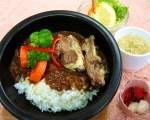
Curry with Spare Ribs over White Rice

950 yen


Tazawako Heart Herb is open from 10:00 till 16:00. Lunch is served between 11:00 and 14:30. 

Nov 17, 2010

Extending your trip to Apple Picking in Yokote City

Akita Prefecture has an ideal condition for apple farming – land, water, and climate — that is why we produce one of the best quality apples of Japan every year. Masuda Area in Yokote City, where Igarashi Orchard (五十嵐果樹園) is situated, is particularly acclaimed as one of the best producers of Akita brand — well balanced in sweet and tangy taste with crispy texture!

Igarashi Kajuen (Orchard) is an apple farm that cultivates with organic fertilizers and lowest amount of agricultural chemical. You can pick both early and late season apples of various kinds. Learning programs welcomes students from kindergarten to middle school. Upon request, visitors can learn how to make jams and juices.

You are in town off season? Well, then try his apple juice (see the photo above). It is available in Tazawako Area as well. Hayashi Yakkyoku (phermacy/souvenir shop in front of JR Tazawako Station) sells packages of his apple juice.


Igarashi Orchard is also known as Mikaku-en.  You can see the beautiful Mt. Kimpo in the back. 


All-you-can-pick experiences are available only for 1,000 yen. When enter, you are given a basket that can contain about 2-3 kilograms of fresh apples. Of course, it is okay to pick and bite on the spot! It’s All-You-Can-Eat as well…

Available on Saturdays, Sundays, and Japanese national holidays from September through November. Reservation required on weekdays.


On this day, we were able to taste 7 different kinds of apples: In the pictures are Ou-rin  (green apple;王林), Jona Gold (red on the left bottom) and the well-known Fuji (right bottom; 富士). You would be amazed how they differ from one another. 


Fuji Apples

 Akita Gold Apples-- they are so good!

On this day, the farmer himself took us a tour around the orchard. This friendly man is so enthusiastic-- he humbly exudes his pride in cultivating apples. We asked him how to pick a perfect apple. "In general, the color is the best indicator. Red apples turn redder by the sunlight as they ripe. Take this one. See the bottom? It's evenly red. I would pick this for you." He grabbed one to hand it to us. 

"Sometimes, though, " he continued, "you can't tell by the colors-- that's when apples are produced using a technique to accelerate the coloring process by reflecting the sunlight. They do turn redder, but that doesn't mean they are sweet as much. They might look perfectly red and delicious, but it would make it difficult to sort out by the sweetness before the distribution. Some farmers still prefer it because appearance could affect how you taste, and they are right. But, at our farm we prefer the natural technique." He smiled, proudly.   

A visit to a orchard or a farm would give you a great unforgettable cultural experience! After all, the food is important part of a culture! 

 Orchard Name
:
Address
:
秋田県横手市増田町亀田旭野15
Telephone
:
(Japan +81) 0182-45-3724
Open Hours
:
9 a.m. until dark

Oct 8, 2010

Finding Organic and Certified Produces

Tazawako Ichi (田沢湖市) is a market that offers you a variety of local souvenirs and snacks. It is also a convenient place across the station to find locally produced fresh vegetables. Are you a health-conscious traveler? Tazawako Ichi could be an interesting place for you!

Magobei’s Jabanero Peppers!


Pension Magobei is a farmer’s inn that was the first to be involved in World Wide Opportunities for Organic Farms. They have been highly conscious in the organic farming, which has been inspiring many foreign WWOOFers (volunteers who seek for an opportunities to gain knowledge in the field) from Japan and overseas.

Magobei is known for the less common produces like wild rice, which they are known for— jabanero peppers are obviously rare in Japan. But here! These deliciously pungent gems warm you up in the cold winter!


Noka-Kobo Odashima’s  Akita Komachi Rice !

Mr. Odashima's Certified Akita Komachi! NEW CROP!!(新米)


A proper quality labeling is required to be certified
as a Specially Cultivated Agricultural Products (特別栽培農産物).


Noka-kobo Odashima (農家工房小田島), is another farmer in Tazawako Area, who is highly motivated in certified farming. Mr. Eiki Odashima represents the farm, who is dubbed as “the old man who loves sake” (酒好きおやじ). Akita Prefecture is surely known for its quality of rice. He is one of those proud rice producers of Akita, whose rice is classified as the #1 quality (一等米) and certified according to the guideline of specially cultivated agricultural products. New crop (新米) is available in a 200g package for only 300yen.

Custom Declarations for Rice?
No-- Now rice is among the NDR (No Declaration Required) items for the personal and household effect. Read the details in Ministry of Agriculture, Forestry and Fisheries Website (Japanese).

Jul 7, 2010

Soba Goro is the our favorite specialized soba (buckwheat noodle) shop in town.

Besides the noodles we have mentioned before, Soba Goro actually have atypical soba item: Soba Pudding.

Soba Goro's Soba Pudding

Ingredients:
Soba (Buckwheat)
Milk
Zarame Sugar (Japanese natural brown sugar)
Granulated Sugar
Mirin
Shoyu (Soy sauce)
Gelatin


This pudding accompanies a packet of sweet and salty sauce. It is creamy and flavorful with roasted buckwheat! The sweetness is rather mild with a hint of saltiness from soy sauce. It might remind you of Mitarashi Dango (sweet rice cake on stick coated with sweet soy sauce). On the top is crunchy roasted buckwheat.

The chef said the secret is brewing strong milk tea with roasted buckwheat!

Sounds so simple but innovative!

Try it at Soba Goro in Tazawako Ichi.

Jun 11, 2010

Stay at Birke and Become a Fan!

Hutte Birke is a family-owned inn within a minute from Tazawako Ski Area. Why am I talking about them now in the summer? Well, here is the reason:


Hutte Birke


Mrs. Sato, the landlady of this minshuku, best known as Birke Eomeoni or Birke Mama, is an energetic and homey woman who can leave you a deep impression as, well, an enthusiastic Tazawako and IRIS promoter!

How she came about is an interesting story. For several years, Korean drama has been very popular in Japan. Winter Sonata was a mega-hit here, which has inspired many people to study Korean language. It is only natural to want to understand the content beyond translation. So she did—she started to learn Korean language, entirely embracing the culture as well.


To make the long story short, for her passion in Korean culture, filming of IRIS at Tazawako Ski Area was such a fortunate coincidence! Even more, when the filming took place in her neighborhood, she offered her place to a crew – just for a slim chance to be a help. As it turns out, he came back on the following day and asked her to share the place for Lee to change the wardrobe.

Her excitement from the day still remains strongly. She has written with more details in her blog, which has been visited by many. Today her inn is becoming one of the IRIS related spots. Guests can see the autograph of the star Lee Byoung-hun and IRIS-related photos displayed next to her family photos—as if it is her wall of honor to celebrate her extended family.


Autograph on the wall


She shares not only her IRIS collection but also a lot of tourist information on Tazawako Area. Talking with her would make you a fan of both the drama and Tazawako Area! That is why she is such an IRIS and Tazawako promoter!

She is admirable also for her savviness in Sansai, wild delicacies. Her meals consits of seasonal delicacies collected by her own hands in the neighboring wilderness. If you are interested in knowing how the locals really eat, she probably would be willing to show you!


Birke Mama!


Another specialty of her is special blend of tea—containing 16 different kinds of wild herbs. The earthy aroma and a hint of natural sweetness have been praised by locals including a chef of Momo-Ya, a restaurant highly conscientious about healthy and high quality ingredients. Now Birke’s tea has been served at Momo-ya as a part of brown-rice lunch special (macrobiotic-inspired).


Birke Blend, lots of good stuff!


List of herbs and its effects.


Drying her herb!

She has a charm that attracts people beyond languages and cultures. Her genuine hospitality makes you feel at home. She is someone who is trustworthy to put up a friend with, because of her compassion for people. That is why travelers from in and out of Japan keep on coming back! Perhaps with her, you can call Tazawako your second home!


Entrance


Onsen!


She has many nostalgic things.

 
A welcoming message written by her sons when they were little.


All the rooms have tatami mats.

May 13, 2010

A Soba Near Waterfall: Komagatake Onsen

Soba Goro is a Soba specialized restaurant with locations at Komagatake Onsen and Tazawako Ichi in front of JR Tazawako Station. They serve Juwari Soba (100% Buckwheat Noodle), the finer variety consists entirely of buckwheat, while the more common variety, Ni-Hachi Soba  (2-8 Buckwheat Noodle) consists of buckwheat and 20% wheat. This means Juwari Soba contains higher nutrition such as amino acids, dietary fibers, and rutin. You think soba is healthy? Choose Juwari Soba--- even healthier!


Komagatake Onsen and Juwari Soba Soba Goro


The Entrance

Soba Goro’s Tazawako Ichi Location is popular among train travelers; however, this Komagatake Onsen location is situated as a part of this inn and mostly visited by overnight guests, day-trippers, and hikers who came for Onsen in Mizusawa Area. The building is secluded from other Mizusawa inns, deep in the forest next to a creek. The best treat for your eye is a beautiful waterfall called Yujo-No-Taki, Waterfall of Friendship.

But first, let us have some treat for our tummy! Our order this day was Kakiage Soba--- recommended by the receptionist. At this location, you first buy a ticket from the vending machine in front of the front desk, which you will show to the server upon entering the restaurant at the end of the hall.


Written in Japanese only, so you can ask for an assistance.


Take this ticket to a server

The interior is furnished with beautiful dark wooden pieces and decorated with antique goods, which give a certain ambiance--- similar to Tsurunoyu and other Soba Goro location. This place is so unique, though, because you see a river and hear the water and it feels like you are out in the nature!


Welcome..


Sit on the counter or a table? You choose.


Help yourself with hot tea or water.


Antique pieces displayed.


A view from our table


Dried persimmons. Hear the sound of river?

Kakiage Soba is a plate of cold soba served with pieces of kakiage tempura (shreded mixed vegetables deepfried). Soba aficionados say that a good soba must have such texture that is hard and chewy at the same time. Soba Goro’s Soba is at its perfection and cooked so fresh--- boiled no more than 20 seconds! As a result, it leaves the distinctive scent of buckwheat which you would enjoy in every moment. At the end of the meal, we were served a pot of flavorful soba-yu (water in which soba was boiled).


Morisoba with Kakiage


Kakiage!

After our indulgence with soba, we proceeded to explore the waterfall, which is a minute away. The mist from the waterfall was so refreshing! We also found many young spring plants near the water. How comforting it was.. we just wanted to stay there forever!


Yujo-No-Taki


To access Komagatake Onsen, you take a road into the forest following a sign. The road directly takes you to the waterfall and Komagatake Onsen, so it’s pretty self-explanatory. Enjoy a soak, soba, and relaxing moment near the waterfall :)


大きな地図で見る