Showing posts with label Sashimaki. Show all posts

Nov 14, 2011

The Annual Harvset Festival Held in the Heartwarming Sashimaki Community!

October and November is the harvest time! Festivals are being held around town. Yesterday the community in Sashimaki area also held the 17th Annual Harvest Festival.

This was the largest community event of the year, at which locals enthusiastically participate in competitions of “Delicious Rice,” “Picked Vegetables,” “Sake no Sakana” (a side dish to drink with), and “Oyaki” (pan-fried rice cake with filling).

Judges represented from the community and the city government, as well as other organizations related to agriculture and tourism. Representing the local tourism industry, Tazawako Tourism Association also engaged in the selecting process as we were pleased with our palates!


The Akita Komachi rice produced in Sashimaki has been recognized as top quality. The 23 different rice samples produced by individual farmers were compared and evaluated in 3 categories; brown rice, cooked rice, and taste.

Brown rice samples --- can you see the differences?

Each rice sample was numbered and judged anonymously. The uncooked brown rice were screened by the experts, while the cooked white rice were scored individually in scale of 1 to 10 with careful attention to details such as aroma, glutinousness, glossiness, preference, taste, and preference ---using all the five senses!

Sake no Sakana Category

In the other categories, the local ladies to show off their skills in the original recipes! “Sake no Sakana” is also referred to as “otsumami,” and it means a dish to be eaten as an accompaniment of alcohol drinks. 18 different dishes were submitted in this category.

 
The winner was "Chrysanthemum and Crescent Seasoned with Sesami Dressing (Left top corner)

Akita has a rich culture of preseved foods. Pickled vegetables are a quintessential example. Here in this competition, many uncommon variations of pickled vegetables were brought in -- such as miso-pickled persimmons, beer-pickled radishes, and spaghetti squash pickled with kankoji, a pickling agent made with rice and rice-malt that is regional specialty in southern Akita!

Pickled Vegetables ("Tsukemono") Category:
Miso-Pickled Persimmons (center right), Beer-Pickled Radish (right second from the bottom), Kankoji-Pickled Spaghetti Squash (Left second from the top).

“Oyaki” is perhaps what makes this festival so unique! None of 6 kinds submitted was common one (plain anko-filled) --- It is a very competitive category, indeed!

Oyaki Category: The winner was filled with Shiso (Perilla) and Miso, left bottom.

After the thorough evaluation (and a lot of eating), the scores were calculated and announced at the following ceremony (more eating followed). The judges unanimously agreed that rice was the hardest to evaluate due to the very subtle differences; but, after all the samples were delicious! Speaking from the product development perspective, a judge insisted: some dishes are so innovative that they should be made into new products! Awards were given to the winners as well as humorous certificates!

 
This community is strongly bonded and displays such humble, humorous, and heart-warming quality. The people warmly welcomes the invited guests and keep us satisfied – which explains the great success of Sashimaki Mizubasho Festival every year!

Apr 19, 2011

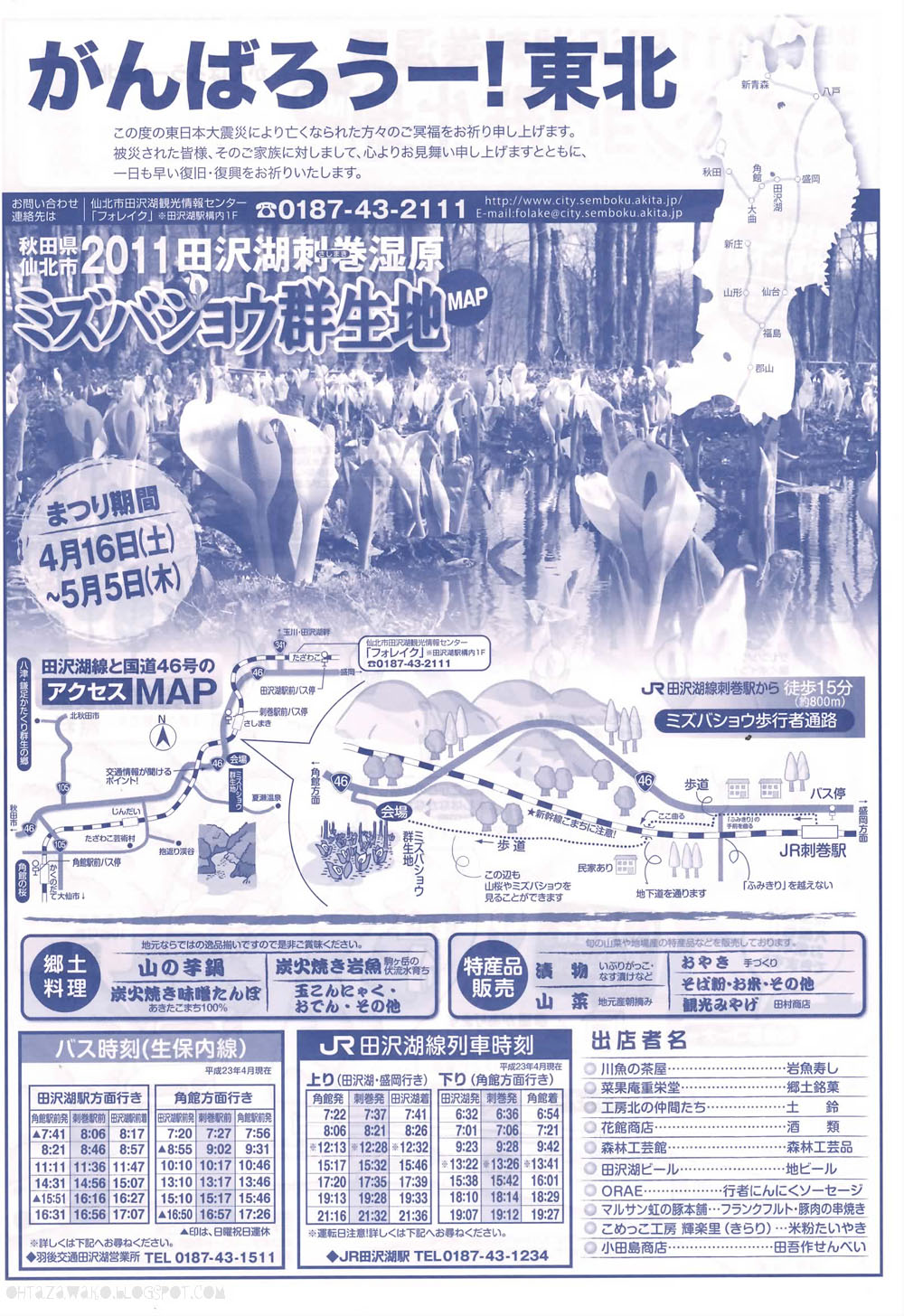
Sashimaki Mizubasho 2011 (Access/ Food / Souvenirs)

has started on April 16th and continues till May 5th.


Access:

DRIVE – Route 46 in between Tazawako and Kakunodate Station. If you are driving eastbound from Kakunodate Area, the colony will be found on your right hand side before JR Sashimaki Station. Parking capacity is 70 cars and free of charge.

WALK -- 15 minutes walk from the nearby JR Sashimaki Station. When you exit the station, make an immediate left. Just follow the event signs and continue walking on the paved way. You may find some wild cherry blossoms and Mizubasho flowers as well, but  you are not there yet; continue until you get to the event site.

BUS – The bus lines connect JR Stations (Tazawako, Sashimaki, and Kakunodate). See the time-table below (left corner) on the flyer.

JR TRAINS – Take a local train on JR Tazawako Line; Shinkansen Express do not make a stop at Sashimaki Station. See the time-table below.


Local Food / Souvenirs:

Traditional Cuisine – Yama-no-imo Nabe (Hot Pot with balls of grated yam), Miso-Tanpo, Iwana (Japanese Char), Tama-Konnyaku, Oden, etc.

Other Local Specialties – Pickled Vegetables (Iburi-gakko, Eggplants, etc), Fresh Sansai (Wild Delicacies), Home-baked Oyaki (rice cake), Buckwheat Flour, Rice, Snacks, and Sweets, etc.

Other Souvenirs-- Iwana-sushi (Pressed Sushi with Japanese Char), Dorei (Pained Clay Bells), Liquors, Woodcrafts Goods, Tazawako Beer (Bottled Craft Beer), ORAE's Sausage with Alpine Leek, Nijinobuta Sausages and Pork on skewers, Rice-flour Taiyaki (fish-shaped pancake with sweet bean paste inside),Tagosaku Senbei, etc.


(Clockwise) Oyaki, ORAE's Sausages, Snacks,Yama-no-imo Nabe, Rice-flour Taiyaki,
Tazawako Beer (Sakura-kobo Beer), Miso-Tanpo, Woodcrafts, Dorei (Clay Bells).


Apr 7, 2011

Sashimaki Mizubasho Festival 2011 (Dates Announed)

Sashimaki Mizubasho Festival 2011
Saturday April 16th - Thursday May 5th, 2011

A colony of Mizubasho is spread as large as 3 hectares (about 7 acres) and coexisting with other rare plants like zazenso amongst an alder forest. The easy accessibility makes Sashimaki’s Mizubasho area so unique—it is spread along national route 46, so you can see it from the windows from your vehicle. The beautiful sight makes many drivers to stop by.

Mizubasho and zazenso both belong to the same species called “skunk cabbages” in English; yet, neither of them do not emit unpleasant odor at all! To tell the differences between the two “skunk cabbages,” it is quite simple: Mizubasho (Japanese Skunk Cabbage) have white flowers and exist abundantly, while zazenso (Asian Skunk Cabbage) has elegant purple and can be found only a few.

A swamp where a clolony of mizubasho can be found. (Photo/Semboku City)

Zazenso means "meditation-plant"-- do you see the monk in meditation right there?


The place is visited by approximately 100,000 visitors during the festival weeks. Tents and prefab will be set up to offer you some local delicacies. On weekends, local traditional dance group come in to perform at the stage. (Read posts from last year.)

More Info:
FOLAKE (Tazawako Tourist Information Center)
TEL 0187-43-2111 or folake@tazawako.org

Dec 24, 2010

Rabbit Illumination at JR Sashimaki Station

JR Tazawako Station has been illuminated last weekend. JR Sashimaki Station (only one station away for Kakunodate) is also illuminated by the community volunteers. Last year was a smiley face: This year is a rabbit face!


The Chinese zodiac sign for the coming year is rabbit. That is why!

We have been delighted by the Sashimaki community. They are the ones who host the Sashimaki Mizubasho Festival in April. Late October, we were invited to their harvest festival, in which the community members –mostly rice farmers— gather to compete on the rice harvest, inventive dishes like pickled vegetables, appetizers, and oyaki (roasted mochi with tasty fillings). It is a great opportunity for them to show off their skills and acknowledge one another’s achievement. The party was attended by many guests like Semboku City mayor and JR Station master.

The awards were given for the food entrees, whose prizes were farming equipments, pillows and alike.  Perhaps one of the best part was when the community group was awarded by JR company, for their great efforts to improve the environment around the station is appreciated. The entire party was full of laughter! We were assured that this is where the Sashimaki humor comes from!

Rice, pickled vegetables, appetizers, and mochi dishes were entered to the competition.


Watch the Sashimaki rabbit alive!

Apr 27, 2010

Flower Festivals Postponed!

The temperature has been so unexpectedly low this year. The blooming date of cherry blossoms in Kakunodate has been postponed more than once. As of today, the cherry blossoms in Kakundate is expected to be in bloom from the 27th and enjoyed through May 9th or so.

The blossoms are said to last long when the temperature remains low during the germination. This has made the flower festivals in Semboku City last longer too!

New Festival End Dates:
Kakunodate Sakura (Cherry Blossom) Festival --- Though May 9th
Sashimaki Mizubasho (Skuk Cabbages) Colony Festival --- Through May 5th
Nishiki Katakuri (Dogtooth Violet) Colony Festival --- Through May 5th

The end days are being pushed forward, which means you get to enjoy the food stall and performances longer! In fact, the cold weather doesn’t seem to cause only troubles --- except for the extra sweater you need to carry--- the blossoms are enjoyed right in the middle of Golden Week, Japanese week-long holidays!

The weather changes so frequently that you never know what kind of weather you get, so make sure you bring an extra sweater with you!


The pictures below are some quick view on the festival in Sashimaki!

Here we go again! Mizubasho is in full bloom.

The food stand selling various pickled vegetables and wild delicacies! The o-bachan was cute :)

Stage performance of traditional music!


Apr 20, 2010

Generating Heat in Sashimaki Wetland !?

Did you know Zazenso generate heat up to 25 degree in Celsius?

Zazenso

According to some sources like Wikipedia and other Japanese websites, Zazenso (Eastern Skunk Cabbage) and other skunk cabbages are able to generate temperature of up to 35 degree. This results in increasing rate of pollination by spreading the pungent odor and attracting fries! The heat mechanism of Zazenso is caused by an unknown reason. Isn’t that interesting?

Zazenso

I feel awkward every time I call both Mizubasho and Zazenso "Skunk Cabbages", because the kinds familiar to us do not stink at all! It is enjoyed by many people here because the white and purple contrast vividly against the dull color of soil after the snow.


Mizubasho

Mizubasho (Japanese Skunk Cabbage) in Sashimaki Mizubasho Colony is in full bloom. It is expected to last until the end of Golden Week (May 5th). This is a place where you can see not only the wetland plants like skunk cabbages, but also Katakuri, Dogtooth Violets. Although only a few Katakuri flowers are found here and there in Sashimaki Wetland, they still appear vivid and adorable with other plants. If you want to see a purple field of dogtooth violets, try Nishiki Katakuri Colony! (Not in bloom until the end of April.)

Not many of them, but surely enough! Pretty Kikuzaki-Ichige (Anemone pseudoaltaica) is easily spotted out.


Japanese Alder Trees seems to be standing as if it's protecting the flowers on the ground.


Mt. Komagatake seen from Sashimaki Area

The wetland plants are spread in the forest of Japanese Alder Trees (Han-No-Ki) in an area as large as 10ha. There are also some other kinds of plants growing wild in this area. It takes about 20 to 30 minutes to walk around.

How to Access and other information on Sashimaki Mizubasho Colony 

Apr 19, 2010

Access to see Mizubasho and Katakuri

Here are some access information to see Mizubasho in Sashimaki Area and Katakuri in Nishiki!


Apr 16, 2010

Sashimaki Mizubasho Colony (Updates)

 Sashimaki's Mizubasho is showing more and more flowers. Some sunnier parts of the area, closer to the Route 46 seems like in full bloom today. The plants spread as large as 3ha, and there are still some areas that are just showing the little tips of flowers. The festival is going to last until May 4th. If you are close, please do stop by!


Apr 12, 2010

Sashimaki Mizubasho Colony: Festival Map

The Mizubasho Festival is now on! It is the merriest community festival for the residents in Sashimaki area. The flower of Mizubasho is rarely seen in Honshu Island, so please don’t miss this chance to take a glimpse of them.

Here is the official map of Mizubasho Festival 2010.


You can also download PDF with some English annotations.

There are some traditional musical performances on stage and rice-cake making (pounding the sweet rice with a big pestle and a mortar.) Some stands of local foods and souvenirs are available as well. The festival continues until May 4th this year.

Apr 9, 2010

Sashimaki Mizubasho Colony Update!

The Mizubasho Festival in Sashimaki is opening tomorrow until May 4th. It was such a lovely weather today, so we went to check out how much they have grown. Mizubasho, Japanese Skunk Cabbage (no stink!) are showing more flowers now!
This is going to be the merriest festival in Sashimaki Area! The locals have been preparing prefab tents for warm and quick food and souvenirs.

More and more showing...


Young Mizubasho


Zazenso ("Plant of Meditation") Does it look like a monk in meditation? I kinda get it now..


Souvenirs and Yama-No-Imo Nabe is going to be served here.


The toilets are available.

Souvenirs being prepared for sale.

Mar 25, 2010

Sashimaki Mizubasho Colony


We heard the sign of spring has finally popped out in Sashimaki Mizubasho Colony.. so we went.

Mizubasho (Lysichiton camtschatcence), known as skunk cabbage in the Western countries, is a plant found in wet lands and swamps in cool mountain areas. How interesting North American species have yellow spathe, the hood-like bract which contains the flowers, and emit a distinct odor, while our Asian skunk cabbage blossom in white and does not smell bad at all!

Mizubahsho, the first one this year.


The wet land of Sashimaki. Still only a few of them are out. Soon the whole area will be covered with white flowers here..


Take the path--- watch out! It's slippery.


Nothing is more comforting than the sound of babbling stream...

Mizubasho has been mentioned in the literature for a few centuries as a plant found in land abundant in water (mizu), resembling Japanese fiber banana (basho). Although you may think it can be found anywhere in Japan for it is known for the richness and variety of water sources, Mizubasho is hardly found in warm and low-altitude land in which many of the urban cities are situated. It can be found only in places with a rare climate condition. That is why many people take a trip to see this precious plant.

Some early birds catching spring..


Still so much snow to melt.


The creek carrying a body of fresh snow-melted water. It was so clear and stinging cold!


Zazenso, Eastern Skunk Cabbage, is named after its resemblance of a monk in meditation (zazen).
You will see it pops out before too long..

Sashimaki Area is one of those few places in Japan where Mizubasho can be observed as in colony. The uniqueness of the Sashimaki Mizubasho Colony is that it spreads over just along the roadside of route 46, so you don’t have to go off the road to take a glimpse of the precious plant.

Obviously, we are not the only ones longing for the springtime. Asian black bears, also known as moon bears that inhibit in this area, are said to eat the flowers and leaves to discharge the body waste after the hibernation. It contains oxalicacid, toxic to human beings, but it is perhaps a favorite of the wild animals.
Mizubasho in Sashimaki are going to be in bloom as soon as the snow melts away just before the cherry blossoms. For many Japanese, cherry blossoms are the sign of Spring; but for us, Mizubasho is--- perhaps, it is a sign of the end of long cold winter.


 Festival  is held from April 17th- May 4th, 2010.

To access: 
   By car: Take route 46 in between Tazawako and Kakunodate Area.
                 (10 mins from Tazawako, 20 min. from Kakundate)
   By train: Take JR Sashimaki Station. 15mins. walk along the sidewalk.
   By bus: Take Ugokotsu Bus bound for Akita City (Kyuko Akita Line),
                  get off at “Sashimaki-eki-mae”, and take walk 15 mins.


Other findings: A little head of Fukinoto (butterbur sprout).

''The mountain straight ahead is Mount Akita Komagatake", Takkochan says in the yellow board.