Showing posts with label Flowers. Show all posts

May 27, 2011

Yellow Field of Tenderstem Broccoli Near Lake Tazawa

The climate has been mild and very refreshing in this season! Come to Tazawako and take a bicycle ride near Lake Tazawa!

The beautiful Nanohana (菜の花), Tenderstem Broccoli flowers, are blooming at the lake! Osawa Area (大沢)is near Kata Bunko (an old elementary school site) and Statue of Tatsuko.  From this direction, you can see two of Akita's landmarks, Lake Tazawa and Mt. Akita Komagatake!


Lake Tazawa (left) and Mt. Akita Komagatake (right)


Apr 19, 2011

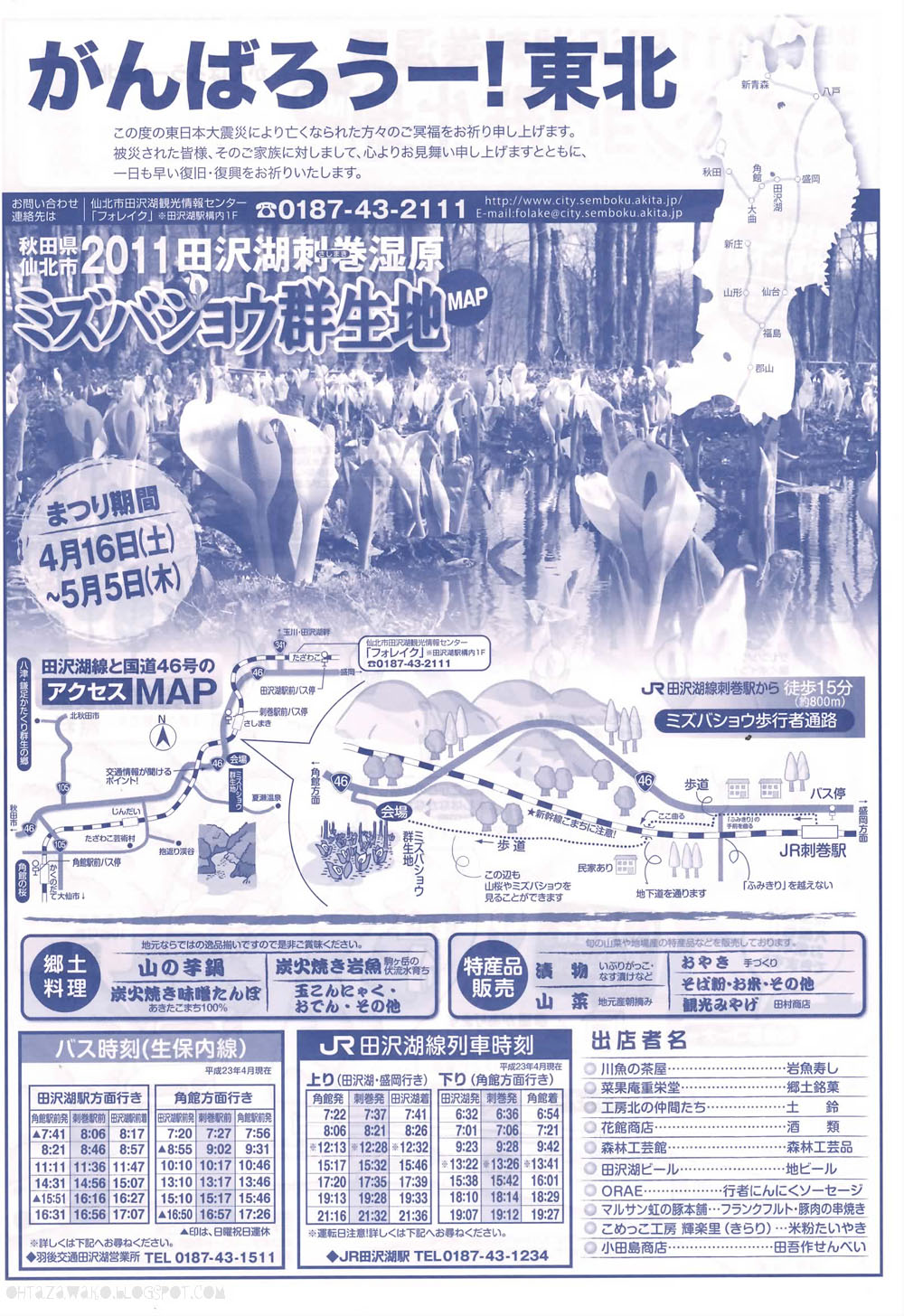
Sashimaki Mizubasho 2011 (Access/ Food / Souvenirs)

has started on April 16th and continues till May 5th.


Access:

DRIVE – Route 46 in between Tazawako and Kakunodate Station. If you are driving eastbound from Kakunodate Area, the colony will be found on your right hand side before JR Sashimaki Station. Parking capacity is 70 cars and free of charge.

WALK -- 15 minutes walk from the nearby JR Sashimaki Station. When you exit the station, make an immediate left. Just follow the event signs and continue walking on the paved way. You may find some wild cherry blossoms and Mizubasho flowers as well, but  you are not there yet; continue until you get to the event site.

BUS – The bus lines connect JR Stations (Tazawako, Sashimaki, and Kakunodate). See the time-table below (left corner) on the flyer.

JR TRAINS – Take a local train on JR Tazawako Line; Shinkansen Express do not make a stop at Sashimaki Station. See the time-table below.


Local Food / Souvenirs:

Traditional Cuisine – Yama-no-imo Nabe (Hot Pot with balls of grated yam), Miso-Tanpo, Iwana (Japanese Char), Tama-Konnyaku, Oden, etc.

Other Local Specialties – Pickled Vegetables (Iburi-gakko, Eggplants, etc), Fresh Sansai (Wild Delicacies), Home-baked Oyaki (rice cake), Buckwheat Flour, Rice, Snacks, and Sweets, etc.

Other Souvenirs-- Iwana-sushi (Pressed Sushi with Japanese Char), Dorei (Pained Clay Bells), Liquors, Woodcrafts Goods, Tazawako Beer (Bottled Craft Beer), ORAE's Sausage with Alpine Leek, Nijinobuta Sausages and Pork on skewers, Rice-flour Taiyaki (fish-shaped pancake with sweet bean paste inside),Tagosaku Senbei, etc.


(Clockwise) Oyaki, ORAE's Sausages, Snacks,Yama-no-imo Nabe, Rice-flour Taiyaki,
Tazawako Beer (Sakura-kobo Beer), Miso-Tanpo, Woodcrafts, Dorei (Clay Bells).


Apr 8, 2011

Dogtooth Violet Colony in Nishiki Area (2011 Update)

Katakuri (Dogtooth Violet) is a species of lily, which can be seen in colonies over a large area amongst a chestnut grove in Nishiki Area. What makes them so unique is the area as large as 20 hectare (49 acre), one of the largest colonies of Japan!

Nishiki town is largely –as much as 90%-- covered by mountains and forests, whose main industries are forestry, agriculture, and eco-tourism.

Katakuri, Dogtooth Violet (Photo/ JR Tazawako Station)

Largest Katakuri colony of Japan located in Nishiki Town (Photo/Semboku City)

Along with cherry blossoms and mizubasho, Katakuri colony in Nishiki area is a popular flower viewing spot in Semboku City. The area is a private chestnut orchard but it will be open to the public during the flower festival. There are some paved walkways that takes you around the park. Have your walking shoes ready!  (Related Posts from 2010) 

Katakuri is expected to bloom from April 15th to May 3rd, 2011. Take Nairiku Jukan Railway and off at Yatsu Station (八津駅). The entrance to the Katakuri area is within walking distance!


Apr 4, 2011

Guided Bus Tour to See 3 Kinds of Flowers in Spring!

Hanakiko Bus (花紀行バス) is a guided tour bus which takes you to three different flower viewing sites in Semboku City.

The bus will pick you up from the nearest bus stop to your hotel in Nyuto Onsen area and Tazawako-kogen plateau area in the morning. It will take you to see three different kinds of flowers: Mizubasho (Asian skunk cabbage) field in Sashimaki, cherry blossoms in Kakunodate area, and Katakuri (dogtooth violet) field in Nishiki area.
 
The bus will go around Lake Tazawa and make a brief stop at Katajiri area, where you can see the golden Statue of Tatsuko. It will take you right back to your nearest bus stop around 17:00 p.m. Time varies depending on your bus stop.

The tour is scheduled from April 26th to May 2nd, 2011. Price per adult is 4,000 yen and 2,000 yen per child. The maximum number of passengers is 42 people. The lunch is not included, but you will have a plenty of time to try various foods near the viewing site in Kakunodate area. The guide is available only in Japanese.


The reservation is required before 5:30p.m. on one day before your schedule. If there is no reservation before 5 days, the tour will be cancelled.


For More Information and Reservation:
Ugo-kotsu 0187-32-4155 (Open 9:00-16:30)


Katakuri in Nishiki Area

Cherry Blossoms in Kakunodate Area

Mizubasho in Sashimaki Area

May 7, 2010

Azalea Festival at Obonai Park

Past week Semboku City was flooded with visitors to the flower viewpoints such as Sashimaki (Skuk Cabbage) Colony in Sashimaki, Katakuri (Dogtooth Violet) Colony in Nishiki, cherry blossoms along the Hinokinai River in Kakunodate.

Although the low temperature has postponed the expected blooming date more than once, many people still chose Semboku City for the driving destination! The Sakura Festival is held until this weekend, May 9th. They are still in bloom---in fact, now that the petals are falling, you might experience a pink shower or even sakura fubuki, a storm of cherry blossoms! Please come by while it lasts!

Cherry blossoms are going to be gone in a few days; finally, our Green Season seems to begin very soon. In the meanwhile, we are expecting another flower festival in Tazawako Area: Tsutsuji Matsuri (Azalea Festival) in Obonai Park!


Azalea (Rhododendron) can be found in many places of Japan; it is also found in centuries old literature like haiku used as a season words that reflect late spring. It seems to be a sign of early summer to us, since we have been waiting for it so long!


*Pictures are from previous years.


Obonai Park is where you can enjoy a stroll amongst approximately 10,000 Azaleas of various hues. The annual Azalea Festival (Tsutsuji Matsuri) is going to be held from May 28th to June 6th. During the festival, food stands are going to be held and the blossoms are going to be lighted up at night.


Obonai Park seems to be rather small for a playground, but considering that it includes hiking trails up on a hill with a few shrines and viewpoints, it is fairly large for a picnic and recreational games. You might see a group of kindergarteners with colorful hats on a school excursion!

Tsutsuji Matsuri (Azalea Festival) at Obonai Park
May 28th- June 6th, 2010.

A route from JR Tazawako Station (15 minutes walk) 

Mar 25, 2010

Sashimaki Mizubasho Colony


We heard the sign of spring has finally popped out in Sashimaki Mizubasho Colony.. so we went.

Mizubasho (Lysichiton camtschatcence), known as skunk cabbage in the Western countries, is a plant found in wet lands and swamps in cool mountain areas. How interesting North American species have yellow spathe, the hood-like bract which contains the flowers, and emit a distinct odor, while our Asian skunk cabbage blossom in white and does not smell bad at all!

Mizubahsho, the first one this year.


The wet land of Sashimaki. Still only a few of them are out. Soon the whole area will be covered with white flowers here..


Take the path--- watch out! It's slippery.


Nothing is more comforting than the sound of babbling stream...

Mizubasho has been mentioned in the literature for a few centuries as a plant found in land abundant in water (mizu), resembling Japanese fiber banana (basho). Although you may think it can be found anywhere in Japan for it is known for the richness and variety of water sources, Mizubasho is hardly found in warm and low-altitude land in which many of the urban cities are situated. It can be found only in places with a rare climate condition. That is why many people take a trip to see this precious plant.

Some early birds catching spring..


Still so much snow to melt.


The creek carrying a body of fresh snow-melted water. It was so clear and stinging cold!


Zazenso, Eastern Skunk Cabbage, is named after its resemblance of a monk in meditation (zazen).
You will see it pops out before too long..

Sashimaki Area is one of those few places in Japan where Mizubasho can be observed as in colony. The uniqueness of the Sashimaki Mizubasho Colony is that it spreads over just along the roadside of route 46, so you don’t have to go off the road to take a glimpse of the precious plant.

Obviously, we are not the only ones longing for the springtime. Asian black bears, also known as moon bears that inhibit in this area, are said to eat the flowers and leaves to discharge the body waste after the hibernation. It contains oxalicacid, toxic to human beings, but it is perhaps a favorite of the wild animals.
Mizubasho in Sashimaki are going to be in bloom as soon as the snow melts away just before the cherry blossoms. For many Japanese, cherry blossoms are the sign of Spring; but for us, Mizubasho is--- perhaps, it is a sign of the end of long cold winter.


 Festival  is held from April 17th- May 4th, 2010.

To access: 
   By car: Take route 46 in between Tazawako and Kakunodate Area.
                 (10 mins from Tazawako, 20 min. from Kakundate)
   By train: Take JR Sashimaki Station. 15mins. walk along the sidewalk.
   By bus: Take Ugokotsu Bus bound for Akita City (Kyuko Akita Line),
                  get off at “Sashimaki-eki-mae”, and take walk 15 mins.


Other findings: A little head of Fukinoto (butterbur sprout).

''The mountain straight ahead is Mount Akita Komagatake", Takkochan says in the yellow board.