Aug 27, 2010

Obonai-Bushi Bon-Odori Festival

Bon-Odori is a festival of traditional dances in Japan that takes place during the o-bon holidays (August 13th- 16th). O-bon is said to be when our ancestor’s spirits return home. It is an important time for the family reunion.

Obonai-bushi, is a traditional folksong from Obonai area in Tazawako. Compare to donpan-bushi or akita-obako, Obonai-bushi might be lesser-known; however, many locals and practitioners are familiar with its song and dance.

Obonai Bushi Bon-Odori Festival was held on August 20th at the plaza in front of JR Tazawako Station.


A bon-odori festival in the JR Tazawako Station Plaza


At 7 p.m-- the locals showed up in various costumes.

Before the dance had begun, a local teachers group had a premier performance of the new version of Obonai-BushiObonai-Bushi Samba!


Finally, the main event has begun.


Intermissions were inserted in between the dances, with performances by Ishigami’s children group.


When Ishigami Traditional Arts Preservation Group had a performance trip to Taiwan, they were befriended with another traditional dance group from Ugo Town in south Akita. They are dancers of Nishimonai Bon-Odori -- one of the three major bon-odoris of Japan.

Nishimonai’s performing group guested at our Obonai Bon-Odori Festival this year, bringing a glimpse of the famed dance to the audience in Tazawako.


Nishimonai Bon-Odori is said to originate in the 13th century. It is known for the ghost-like but elegant flow in movement accompanying the high-pitch flute and low beats of drum. The tradition had been once interrupted and banned during the 1920s because the local police considered it to be too “disturbing and mind-stirring.”


Aug 25, 2010

The Shirahama Area at Lake Tazawa

“Which part of Lake Tazawa do you recommend?”

 
Some day-trippers to Lake Tazawa, Shirahama (白浜)would be our choice of recommendation. It is also known as Haruyama (春山) area which is most convenient in terms of transportations, restaurants, and recreational activities.

 
Access from JR Tazawako Station-- Take a Ugo Kotsu bus on any of the following lines:
  •  Komagatake Sen (駒ケ岳線)
  •  Nyuto Sen (乳頭線)
  • Tamagawa Sen (玉川線)
  • Tazawako Isshu Sen (田沢湖一周線

 
“Tazawakohan” is the bus stop-- hard to miss. Most bus lines connect here. It will take you a center with  where souvenir shops, restaurants, rental services, and hotels are located.

 
Souvenir shops like Kyoei Paresu and Tazawako Rest House are right off the stop. Kyoei Paresu is a souvenir shop where you can see Akita dogs. Tazawako Rest House is another souvenir shop on the corner which manages Tazawako Yuransen (Pleasure Boats). To-Go food stand is there also.

 
Across from the parking lot is the beach known as Shirahama-- literally meaning “white beach”. The beach sand is rich in quartz and used to be famous for its rare attributes, nakisuna, “crying sand (singing sound)” – a sand that produces a high pitch sound under pressure of steps. Due to the environment shift for whatever reason, the sand is not “crying” any more.

 
The lake water comes from the river systems of surrounding region. The water level changes seasonally and susceptible to the precipitation. Driftwoods, pine-cones and chestnuts could be readily found in the beach.

 
Recreational activities in Shirahama include paddling boats, swimming, cycling, and walking.

 
Restaurants in Shirahama serve teishoku (or set meals), noodle soups (ramen, udon, soba, etc), fast-foods (charcoal-broiled chars, ice-creams, kiritanpo).

 
Restaurant ORAE is located on the northern edge of Shirahama area. ORAE’s unique foods— fusion of Akita’s regional delicacies cooked in western style. ORAE's microbrewery, Kohan No Mori Beer is awarded internationally a number of occasions.

 
To the south of Shirahama area is Kenmin No Mori, where you can ride around your bike and see a panoramaic view of the Lake Tazawa and Mt. Akita Komagatake.

Aug 24, 2010

Umezawa Sasara Performed at Kimpo Shrine Annual Ceremony

Umezawa Sasara at Kimpo Shrine

Sasara is a variation of shishimai, a Japanese traditional Lion Dance. The traditional band of Umezawa Sasara performed at the annual ceremony at Kimpo Shrine, in Tazawako Area.


The History of Two Sasara Styles: the Nambu and Mito

Semboku Region still has various forms of Sasara Dances — each in unique costumes, dances, and music. Umezawa Sasara (梅沢ささら) is a good example of Sasara, which is said to preserve its most primitive form influenced by the Nambu Clan in the present Iwate Prefecture.

There are schools of Sasara in general: the Mito and the Nambu styles. The former is said to have been brought by the Satake Clan when they were ordered to re-locate from Tokiwa to Dewa, the present Ibaraki to Akita Prefecture.

The Nambu Style, the latter, is said to have already existed when the Mito style was introduced here. Most Sasara in Tazawako area are said to have been brought from Shizukuishi, the western border town of the Nambu territory via Hosendai, a region in Tamagawa area, and finally spread to other Semboku region.

The Nambu Sasara is also said to be associated with Yamabushi style— “Yamabushi” meaning the Japanese mountain ascetic hermit who is in pursuit of the enlightenment through the nature.

Also, it is said that when the Satake Clan was forcibly transferred to Akita, the Sasara -- mimicking the moves of the Shinto guardians (lions) in order to ward off the evil spirits -- had led the procession so that the Clan could safely enter the unfamiliar territory.


The Manner of Lion Dance:

The group is commonly consisted of 5-6 people: three lions, flute players, and occasionally another person with a mask. They stroll around the town and visit every house, to show a performance and ward off the evil spirits to wish the household’s agricultural fertility, wish fulfillment, safety, and good health.

The flute player and the lions.

On this final day of Umezawa Sasara performance, the group danced at Kimpo Shrine for both the enshrined deity as well as the attendees at the Reitaisai (annual ritual ceremony).


Divine! The Cedar Rows at Kimpo Shrine.

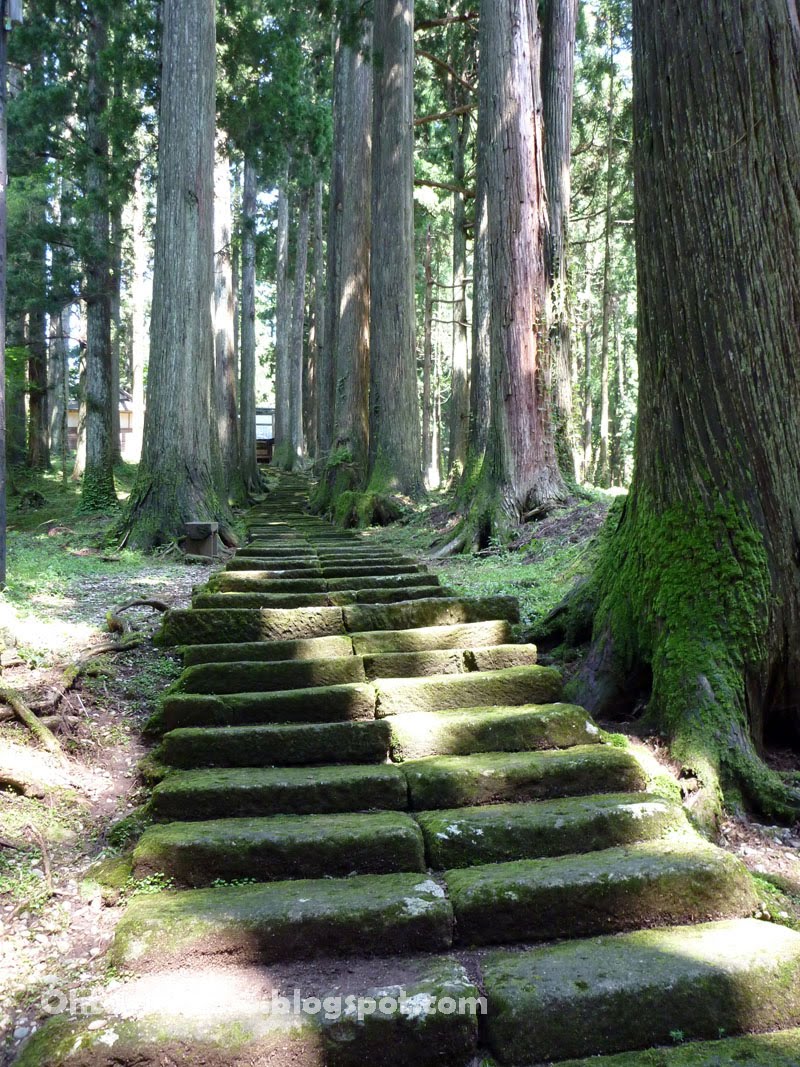
Rows of Sugi, or Japanese cedars, at Kimpo Shrine are designated as the Natural Monument of Akita Prefecture. The rows connect from the Sanmon Gate, where the two Buddhist guardian statues stand, and all the way up to the shrine building.

 
"Cedar Rows of Kimpo Shrine"


These trees, 40 of them on the right and 41 on your left, are said to be about 350- 600 years old. According to the locals, many gigantic trees in the surrounding area were cut down during the wartime for the ship-building—except for these cedar trees!

That is why many hidden pockets of forests with ancient trees can be found in this region. These cedar rows are one of the fine examples.

Walking on the stone-paved staircase covered with moss, you would feel like you are being protected by the trees. So divine!


Aug 23, 2010

Kimpo Shrine's Annual Ritual Ceremony

 
Kimpo Shrine's main building structure is open to the public on few occasions.

Kimpo Shrine has served as an important center for worshippers of both Shintoism and Buddhism, particularly as a sacred site for the farmers who valued livestock raisings as a crucial industry.

It is why you could find many paintings of horses in the the haiden oratory inside the main shrine. Each painting is painted on a solid piece of Sugi, or Japanese Cedars.


Inside of the main shrine building

 A view of the main shrine from the oratory through the walkway.


A wooden sign with a Japanese calligraphy of Kimpo Shrine.


Wooden statues of horses are found.


Many paintings of horses are on display-- can be traced back to the Meiji era (circa. 1900)!


All these are horses.. yes, more than hundreds of them!


The main shrine is in public view only on a few occasions occasions such as Reitaisai, or the annual public ritual. Kimpo Shrine held its Reitaisai last week, in which we had a precious opportunity to catch a glimpse of some important articles.


At the ritual, attendee gathered to pay a visit to the honden, or the main shrine, where the most important articles are enshrined. The oratory and the main shrine are connected with a long walkway, which is accessible only to the Shinto priests.


A purification ceremony before the main ritual begins in the building.


Now following the priests into the shrine..


The ceremony begins.


Aug 22, 2010

Kimpo Shrine: A Site of Shinto-Buddhism


Kimpo Shrine's Main Structure


Kimpo Shrine is one of the oldest shrines in Tazawako Area, founded  in the 8th century. It is known for the giant rows of Sugi, so-called Japanese Cedars (Cryptomeria), which are registered as a Prefecturally Designated Natural Monument.


Walkway to the main shrine along the cedar rows.

The Shrine’s uniqueness lays in that, despite of being a Shinto Shrine, traces of Buddhism and Pre-Buddhist Worship of Mountains could be found as well.


The name, Kinpo Jinja, is the most apparent example. “Jinja” is, as commonly refers to, a Shinto Shrine: “Kimpo” refers to an existing holy mountain in Nara Prefecture that is said to be a sanctuary for Sangaku Shinko (山岳信仰), Pre-Buddhist Worship of Mountains. Mt. Kimpo is also closely associated with Zen Buddhism as it also considers mountains as sacred place.

The shrine is located on a hillside embedded in a deep forest. Upon arriving, the Sanmon Gate (山門) welcomes you with a pair of magnificent wooden statues: The Guardians of Buddha, The Nio Statue and The Kenchiku Rikishi Statue. These are quintessential symbols of Buddhist temples. This gate was created in 1857 and has been designated as Semboku City’s Important Cultural Properties.


Gates after gates..

After the Sanmon Gate is the cedar rows.


The Guardian of Buddha, Nio.


Another Guardian, Kenchiku Rikishi, or the Building Sumo Wrestler.


Up on the staircase for about 5 minutes through the overwhelming cedar rows, another gate will welcome you-- the torii gate, a symbol of Shinto Shrine. A stone monument inscribed as “Kimpo-Zan” (金峰山;Mt. Kimpo) tells you that you are now in the holy site for the Sangaku Shinko.

Historians say the Shrine served as a significant site for both Shintoism and Buddhism probably up until the Meiji Era (1868- 1912).

The religious complex among Japanese people seems to confuse many non-Japanese people. Perhaps, a visit to such Shinto-Buddhism site as this Kimpo Shrine in Tazawako could give you a clue to solve your mystery.


Finally reaching to the precinct.


A Stone Monument.


Now you see a pari of Komainu, Lion-Dogs, are the Guardians of the Shinto Site.


On your right.

On your left.


Oops-- so at this shrine, it was actually not only a pair of big Komainus AND a little one.

Temizu-ya, or a place for purification before you enter the holy site.


Goshinboku, the Holy Tree, stands so magnificently. Wonder how old..


Just when we were talking about the holiness of the site, a snake (?) appears from the holy tree!
Wow.  (Or, is it a snake?)


A statue is being enshrined in the box.


The door of the building is open when there is an event.


This structure, Haiden, was built in 1752.


ACCESS: Kimpo Shrine is located in Jindai Area, in-between Tazawako Station and Kakundoate off Route 46. From the nearby station, a taxi is recommended since it is not within walking distance. For More information, contact Folake. A parkig lot is available next to the gate.

ALSO: A small park with a fish pond and a public restroom is available adjacent to the parking lot.

The pond and public restroom.


The pond.